
Coordinated Tracking and Stability Control
Research Area 02
Brief
This project studies how the stability analysis guide an automated vehicle to continue following its desired path while remaining dynamically stable near the limits of tire adhesion. The central problem is to coordinate tracking performance and stability intervention at limits such as high-speed or low adhesion.
Challenge
Aggressive path-tracking commands can increase lateral tire demand precisely when the available stability margin is small. Without a stability controller may not recover the vehicle from unstable, while an overly conservative controller intervention can significantly degrade path-tracking performance under extreme conditions.
Approach
- Controlled Stability Region-Guided Lateral-Longitudinal Trajectory Tracking for Autonomous Vehicles.
If the embedded video cannot be played, watch it directly on YouTube →
- Hardware-in-the-Loop (HiL) platform design.
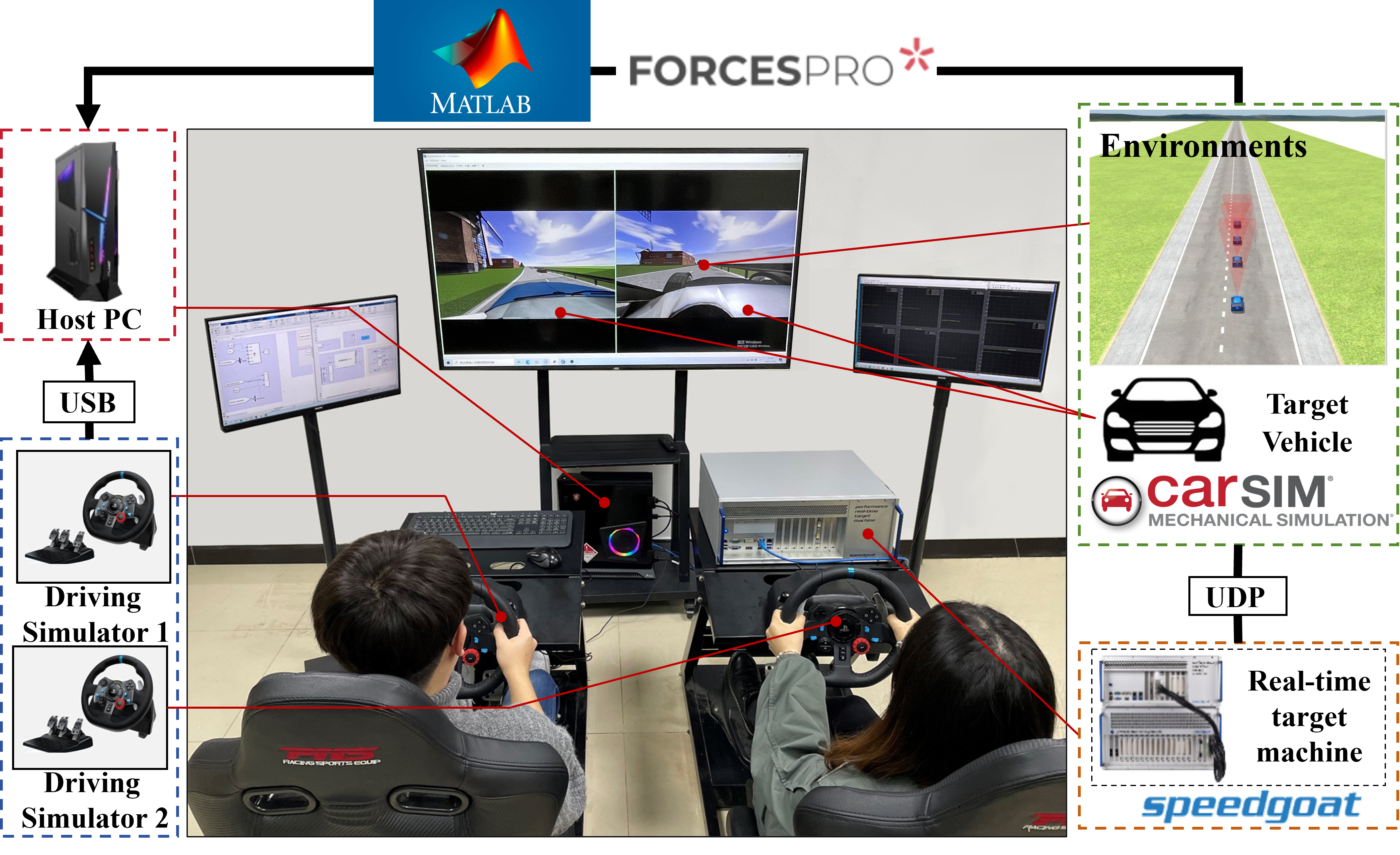
- learning-model enhanced motion control (in progress…)
Related publication
Chengye Wang, Shaoyang Shi, Yu Zhang, and Yechen Qin, “Controlled Stability Region-Guided Lateral-Longitudinal Trajectory Tracking for Autonomous Vehicles”, IEEE Transactions on Industrial Electronics, under review.
Chengye Wang, Yu Zhang, Xuepeng Hu, Shaoyang Shi, Jingqi He, and Yechen Qin, “Coordinated Tracking and Stability Control of Automated Vehicles at the Limits: A Controlled Stability Region Approach” 2026 IEEE 29th International Conference on Intelligent Transportation Systems (ITSC), accepted.
Chengye Wang, Yu Zhang, Xuepeng Hu, Haipeng Qin, Guoli Wang, and Yechen Qin, “Real-time multidimensional vehicle dynamic stability domain calculation and its application in intelligent vehicles,” SAE International, ICVS 2025.
Yu Zhang, Chengye Wang, Fu Du, Mingming Dong, Yechen Qin, and Ming Mao, “Dynamic Region of Stability Integrated Path-tracking Control for Intelligent Vehicles,” Chinese Journal of Mechanical Engineering.